



The revised Well-Managed Highway Infrastructure Code of Practice puts greater emphasis on whole-service performance, benchmarking, customer insight and continuous improvement. For Local Highway Authorities, the challenge is turning those recommendations into practical evidence. The NHT Network can help.
The publication of the revised Well-Managed Highway Infrastructure Code of Practice on 14 October 2026 marks an important development for the highways sector.
Published by the UK Roads Leadership Group (UKRLG), the updated Code reinforces the importance of managing highways as a complete service, rather than focusing solely on the physical condition of the network.
It places greater emphasis on understanding how effectively services are delivered, what they cost, how they are experienced by customers and whether they are achieving the intended outcomes for local communities.
For Local Highway Authorities, this brings an important question into focus:
How can you demonstrate that your highways service is being managed effectively, that performance is being monitored and that decisions are informed by meaningful evidence?
This is particularly relevant as authorities prepare for future highways transparency reporting, where the ability to present clear, consistent and meaningful information will be increasingly important.
The good news is that authorities do not necessarily need to start from scratch. The NHT Network has been providing structured performance measurement, customer insight and benchmarking for many years. Its services offer a range of complementary evidence that can help authorities respond to the principles set out in the revised Code and strengthen their approach to performance reporting.
The shift towards whole-service performance
One of the most significant developments in the revised Code is Recommendation 19 – Service Performance and Benchmarking, within Section A.5.6, Network Performance Knowledge.
It states that authorities should:
Monitor, review and benchmark whole-service performance, using evidence from asset, operational, financial and customer outcomes to support continuous improvement.
This is an important distinction.
Managing a highway network is about more than maintaining roads in good condition. Authorities also need to understand how their services operate, how efficiently resources are used, what customers experience and whether the service is achieving its intended objectives.
For example, improving asset condition does not necessarily mean customer satisfaction will improve. Equally, increased expenditure does not automatically translate into better service outcomes.
The Code encourages authorities to bring these different perspectives together to build a more complete understanding of performance.
How NHT can help
NHT provides several complementary sources of evidence that support this whole-service approach:
- Performance Management Framework (PMF): A structured approach to measuring, monitoring and comparing highway service performance.
- Public Satisfaction Survey (PSS): Consistent national customer satisfaction data, allowing authorities to understand resident perceptions, compare results and monitor changes over time.
- CQC Benchmarking: Comparative cost, quality and carbon information to help authorities understand efficiency, performance and value for money.
- Peer Groups and Knowledge Sharing: Opportunities to explore performance differences, share experience and learn from other authorities.
Used together, these services provide a foundation for understanding performance across different aspects of a highway service.
The important next step is to ensure the evidence is being used within the authority’s own performance management, service planning and decision-making processes.
Looking beyond individual performance indicators
The revised Code also reinforces the importance of organisational knowledge and meaningful performance management.
Sections A.5.7 and A.5.7.1–8 encourage authorities to adopt a balanced approach to performance measures, linking service objectives, levels of service, investment, risk and outcomes.
Why does this matter?
Because individual performance indicators rarely tell the whole story.
An authority might report improving road condition while residents remain dissatisfied with the quality or speed of repairs. Expenditure might increase without a corresponding improvement in service outcomes. A particular measure might appear positive, while other indicators reveal pressures elsewhere in the network.
Looking at these measures in isolation can lead to an incomplete understanding of what is happening.
The real value comes from considering the relationships between them.
How NHT can help
NHT gives authorities an opportunity to bring together evidence from the PMF, PSS and CQC rather than treating each set of results as a separate exercise.
For example, authorities can consider:
- How does customer satisfaction compare with reported service and asset performance?
- Are changes in expenditure reflected in changes in performance or customer experience?
- Are there areas where operational performance appears strong but residents remain dissatisfied?
- Are the findings informing asset management strategies, works programmes and investment priorities?
- Is the evidence being presented to senior leaders and elected members as part of a coherent picture of service performance?
The revised Code provides a useful prompt to review how existing information is being used and whether different sources of evidence are informing decisions together.
Benchmarking: understanding performance in context
Benchmarking is another area given explicit recognition in the revised Code.
Sections A.5.7.9–10 highlight the value of comparative performance information in supporting informed decision-making, transparency and continuous improvement.
But benchmarking should be about much more than identifying which authority has the highest or lowest score.
It is about understanding differences, exploring the reasons behind them and learning from approaches that may be delivering positive results elsewhere.
The Code also recognises the importance of local circumstances. Network characteristics, demographics, funding, service standards and operational arrangements can all influence performance.
A meaningful comparison therefore needs to consider the environment in which each authority operates.
How NHT can help
NHT’s national datasets, benchmarking reports and peer-group activities provide authorities with opportunities to:
- Compare performance against national results and appropriate peer authorities.
- Monitor changes over time and identify emerging trends.
- Investigate differences in performance and potential areas for improvement.
- Understand performance in the context of network and service characteristics.
- Share experience and learn from other authorities.
- Use comparative evidence to support discussions about resources, priorities and service delivery.
NHT’s CQC analysis is particularly relevant here, bringing cost, quality and carbon information together to support a more informed assessment of relative efficiency and performance.
The objective is not simply to report a comparative position. It is to understand what the results mean and what can be learned from them.
Customer insight: understanding the experience of local residents
The revised Code also gives clear attention to customer service and satisfaction.
Section A.3.6 highlights the importance of representative customer evidence, consistent approaches to measuring satisfaction, monitoring trends and making comparisons with other authorities.
This recognises something that can sometimes be overlooked in highway management: the technical performance of a network and the experience of the people using it are not necessarily the same thing.
A road may meet an engineering standard, but residents may still be concerned about its condition. A maintenance programme may be progressing, but people may not understand what work is being undertaken or when improvements will be visible.
Understanding these experiences is an important part of managing a public service.
How NHT can help
The NHT Public Satisfaction Survey provides a nationally consistent approach to understanding public perceptions of highway and transport services.
It allows participating authorities to:
- Understand what residents consider important.
- Identify areas where satisfaction is particularly strong or weak.
- Compare local results with national and peer-authority findings.
- Monitor changes in public perceptions over time.
- Explore differences in how customer groups experience services.
- Use resident feedback to inform service priorities and improvement discussions.
The value is not simply knowing whether satisfaction has increased or decreased. It is understanding what residents are telling the authority and considering that feedback alongside operational and asset information.
This provides a more balanced evidence base for service planning and decision-making.
Demonstrating value for money and the outcomes of investment
Financial pressure remains a significant challenge for highway authorities.
The revised Code reinforces the importance of evidence-based investment decisions and understanding the implications of different choices.
Sections A.7.8 and A.7.9 focus on the need to understand not just how much is being spent, but what that investment achieves.
This means considering costs, efficiency, service outcomes, risks and the potential consequences of different investment decisions.
For authorities, being able to explain the relationship between expenditure and outcomes is an increasingly important part of demonstrating value for money.
How NHT can help
NHT’s CQC benchmarking brings cost, quality, customer and carbon information together, helping authorities examine different aspects of service efficiency and performance.
When considered alongside PMF and PSS evidence, this can help build a broader picture of how resources and service delivery relate to operational performance and customer outcomes.
For example, comparative evidence can help authorities investigate why differences in expenditure do not necessarily translate directly into differences in asset condition or resident satisfaction.
This can support discussions about funding priorities, maintenance approaches, investment choices and the value being achieved from available resources.
It does not provide an automatic answer to every funding or investment question. It provides evidence that can help authorities ask better questions, explain their decisions and make a more informed case for the services they deliver.
Continuous improvement and learning from other authorities
The revised Code also encourages collaboration, shared learning and continuous improvement.
Sections A.1.1.8 and A.5.7.8–10 recognise the value of sector-led forums, regional groups and peer exchanges.
This is an important principle. Authorities do not have to develop every solution independently, and differences in performance can provide valuable opportunities to learn.
NHT has always placed collaboration and shared experience at the heart of its approach.
Through network meetings, peer groups, benchmarking activities and shared discussions, members have opportunities to explore different approaches to service delivery and understand the practical implications of their findings.
Benchmarking can identify where a difference exists. Discussions with other authorities can help explore why it exists and whether there is anything useful to learn from it.
That is how comparative information can become a practical part of continuous improvement.
What does this mean for future highways transparency reporting?
The revised Code and highways transparency reporting are closely connected by their emphasis on understanding and communicating service performance.
Transparency reporting is an opportunity for authorities to demonstrate how their highway services are managed, what is being achieved and how performance is being monitored.
However, reporting information is not the same as understanding it.
Simply presenting figures for expenditure, road condition, maintenance activity or customer satisfaction does not necessarily explain how these measures relate to one another, what they reveal about service performance or what action may be needed.
The revised Code provides a useful framework for thinking about that wider picture.
It encourages authorities to consider evidence across asset condition, operational delivery, finance, customer experience and outcomes – and to use benchmarking and performance management to support improvement.
This is where NHT can make a practical contribution.
The PMF, PSS and CQC provide established sources of performance, customer and comparative evidence that authorities can draw upon when reviewing their services and developing their approach to reporting.
For example, an authority could use:
- PMF information to support its understanding of highway service and network performance.
- PSS results to demonstrate what residents think about the services they receive.
- CQC benchmarking to examine relative cost, quality, efficiency and carbon.
- Peer comparisons to understand performance in context and identify opportunities for learning.
Together, these sources can help authorities move beyond presenting individual figures towards explaining what the evidence means.
It is important to recognise that NHT does not replace an authority’s own statutory responsibilities, internal management information or the need to complete the relevant transparency returns. Nor does membership automatically demonstrate compliance with every recommendation in the Code.
Rather, NHT provides complementary evidence and benchmarking that can help authorities support their own reporting, performance management and continuous improvement arrangements.
Five practical steps authorities can take now
The revised Code provides a timely opportunity to review existing arrangements and consider whether the evidence already available is being used effectively.
Here are five practical steps:
1. Review your existing performance evidence
Consider how asset, operational, financial and customer information is currently collected, reviewed and reported. Identify whether important areas of service performance are missing or considered separately.
2. Bring different measures together
Look at how PMF, PSS and CQC results can contribute to a more complete picture of service performance. Consider whether the findings support or challenge one another.
3. Make benchmarking part of the improvement process
Use national and peer comparisons to identify strengths, investigate differences and explore opportunities to learn from other authorities.
4. Demonstrate how evidence informs decisions
Consider how performance information and customer insight influence service priorities, investment discussions, works programmes and improvement plans. Make the connection between evidence, decisions and subsequent review clear.
5. Share experience and learn from others
Use sector networks and peer discussions to explore challenges, approaches and lessons learned. The revised Code recognises the importance of collaboration, and this is an opportunity to make greater use of it.
Making the most of the evidence available to you
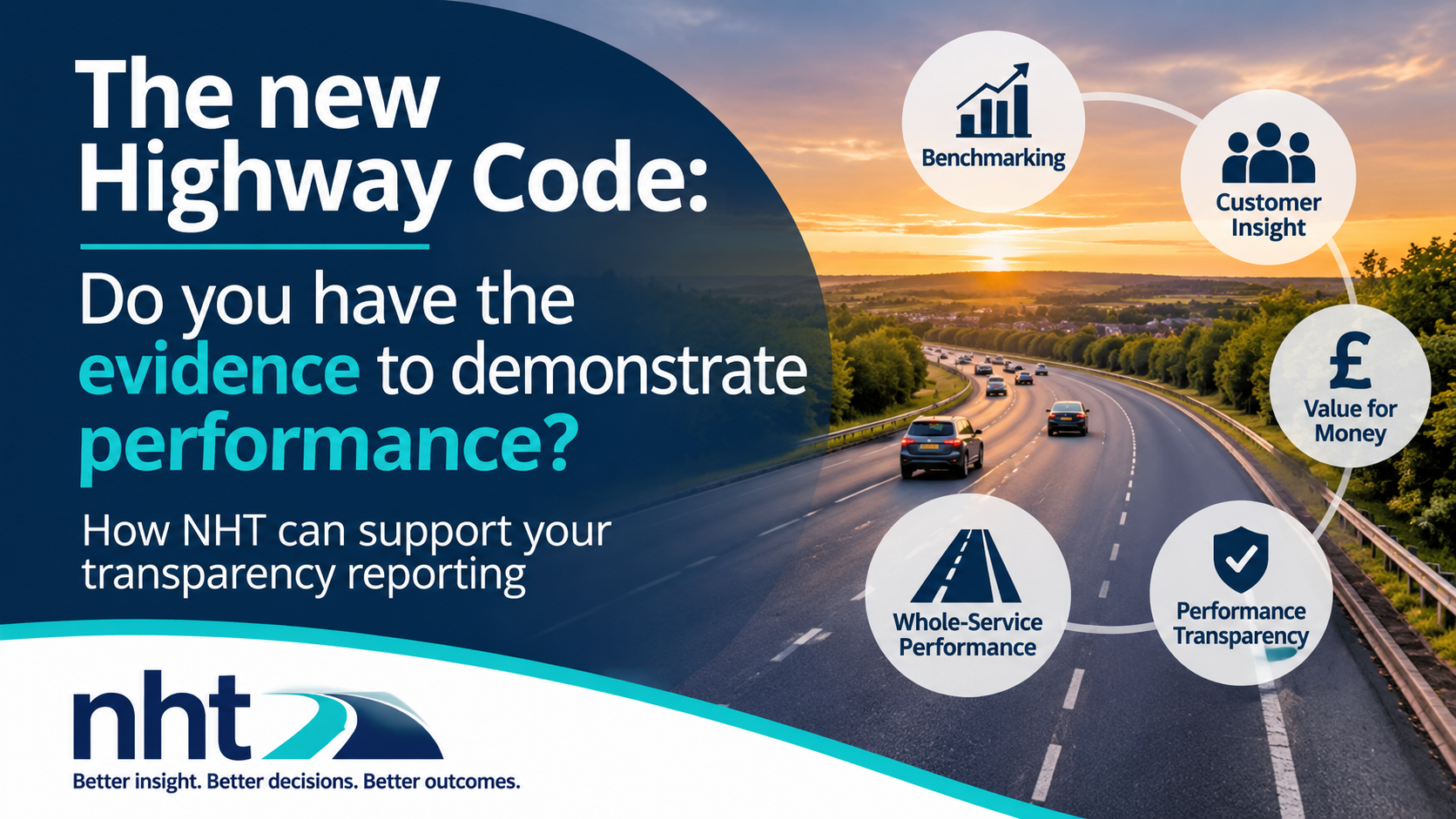
The revised Well-Managed Highway Infrastructure Code of Practice reinforces principles that are central to effective highway management: whole-service performance, customer insight, benchmarking, value for money and continuous improvement.
For authorities, the challenge is putting those principles into practice and demonstrating how they influence the way services are managed.
That requires more than collecting data. It requires reliable evidence, meaningful comparisons, an understanding of local circumstances and the ability to bring different measures together.
The NHT Network has been supporting authorities in these areas for many years. Its Performance Management Framework, Public Satisfaction Survey, CQC benchmarking and peer-learning activities provide complementary sources of evidence that can help authorities strengthen their performance management and support their approach to transparency reporting.
If your authority is reviewing its approach to the revised Code or considering how to strengthen its highways transparency reporting, NHT can help you make more of the evidence you already have – and identify where further insight may be needed.
Find out more about the NHT Network, its benchmarking services and how they support Local Highway Authorities.
Better insight. Better decisions. Better outcomes.